Green Technology Innovations
INTRODUCTION
Circularize for Change is a global movement that is accelerating the transition to a circular economic system through advocacy, policy research, and innovation. We aim to drive this transition in a systematic and comprehensive way, taking cognizance of the social, economic, and policy barriers to the adoption and implementation of the circular economy. Achieving this systemic shift will not only require a shift from a linear economic model to a circular economic model. A true shift also requires addressing and tackling the root causes embedded in behavioral patterns, societal and cultural norms, and uncoordinated structures that work against good environmental stewardship.
Environmental stewardship can be defined as a set of values that individuals, communities, and cultures draw upon to form their relationships and interactions with the environment and its resources (Van Putten et al., 2014, p. 3). Such interactions (positive or negative) are caused by internal and external factors. Internal factors that affect human interactions with nature are not always imminent. They include values, socialization, knowledge, and the level of awareness of the impact of human behaviour on the environment. For instance, a child who grows up in a community where littering is commonplace may grow up into an adult lacking awareness of the repercussions of littering on the environment and personal well-being. Similarly, within a culture where car ownership and driving denote high status and affluence, commuting by bicycle may be stigmatized despite being a clean and cheaper alternative to transportation.
External factors that influence people’s negative or positive associations with the environment include, but are not limited to, institutional and economic barriers. In the absence of good public transportation, refurbishing, and recycling facilities, or policy incentives, individuals, businesses, and communities may choose to dissociate with good environmental stewardship as a cheaper and more convenient alternative to living. In the context of the bicycle analogy, a city's failure to provide safe lanes for cyclists compels its citizens to prioritize personal safety over the environmental repercussions of utilizing fossil-fueled automobiles.
It is widely accepted that environmental challenges—whether engineered by internal or external factors—are complex and persistent. Addressing pollution, biodiversity loss, and climate change will necessitate collaborative efforts from individuals, institutions, communities, governments, and civil society to effect coordinated, long-term solutions. Within this framework, we advocate for the use of systems thinking to analyze human interaction with nature and facilitate a transformative change from exploiting nature's resources to renewing them for the betterment of both people and the planet.
THE STORY OF HUGHMAN, THE FROG, AND THE JACUZZI
In the peaceful countryside town of Eco, there existed an extraordinary bond between a frog and his closest companion, Hughman. Their unbreakable friendship was grounded in deep understanding, affection, and trust. The frog, being amphibious, depended on land and water for the well-being of himself and his family. On warm days, the frog and his kin sought solace in the tranquil pond of Eco to cool off and regulate their body temperatures. Conversely, when the pond grew chilly, they would emerge to bask in the comforting warmth of the sun. Hughman, a land-dweller, would occasionally visit the pond for a refreshing swim or to fetch a pail of water. Their understanding was clear: the frog and his family were tasked with keeping the insect population in check on land and providing sustenance to terrestrial animals, ensuring the survival of Hughman and his family. In return, Hughman faithfully maintained the cleanliness and integrity of the freshwater habitat for the survival of the frog and his family, while also regulating temperatures on land and in the pond to ensure the conditions were suitable for both of them to thrive.
On a warm and sunny afternoon, Hughman devised a devious scheme to rid himself of the frog and his entire family. His motivation was to claim the pond area for hosting his guests and family gatherings. Deceptively, he lured the frog and his kin by fabricating a tale about a remarkable self-regulating pond that could adjust its temperature with the flip of a switch. He named this fictitious creation "the Jacuzzi." Initially, Hughman set the temperature of the Jacuzzi to its highest setting and persuaded the frog to take a dip, assuring him that it posed no danger. However, the moment the frog leaped into the water, he swiftly sprang out, yelping in distress. Incensed by Hughman's failure to caution him about the scorching heat, the frog was enraged. Overcome with regret, Hughman humbly pleaded with the frog for a chance to make amends for his misdeed.
Frog and Hughman had a heart-to-heart conversation, and Hughman assured Frog that he would join him in the jacuzzi to prove that the water temperature was safe. As they soaked in the warm waters for hours, Frog found the experience so relaxing that he invited his family to join them. With a kind heart, Frog wanted his loved ones to share in the enjoyment of the jacuzzi. At this point, Hughman, with a deceitful plan, quietly exited the jacuzzi to make space for Frog and his family. Little did Frog know, Hughman had maliciously adjusted the temperature settings to slowly raise the heat to a dangerous level. Hidden from view, Hughman maliciously observed as the water temperature rose, causing Frog and his family to cry out in agony. An observer named Bird, who witnessed these events from a nearby tree, approached Hughman and pleaded with him to stop the suffering and release Frog and his family. However, Hughman callously ignored the plea, refusing to intervene and allowing the dire situation to unfold.
Within an hour, Frog and his family perished, leaving the once vibrant pond eerily silent. Hughman, the architect of their demise, departed the scene of the massacre with a twisted sense of triumph. Eager to celebrate his victory, he summoned his family and all the living creatures of Eco to a grand barbecue party at the very pond where Frog and his kin had thrived.
As the news of the Frog’s extinction spread, the insects, emboldened by the absence of their natural predator, swarmed to the party. They devoured every morsel Hughman had prepared, their tiny mandibles clicking greedily. Not content with the feast, the insects then descended upon Hughman's cornfield, ravaging the crops with insatiable hunger. The once lush field soon lay in tatters, stripped of its bounty.
The celebration turned to chaos as the insects settled on Hughman's family and friends, biting fiercely and leaving behind a host of diseases. The air buzzed with the frantic swatting of hands and cries of discomfort. In the days that followed, the bites festered, and sickness spread like wildfire. Hughman and his kin, once robust and thriving, were soon consumed by starvation and illness, leading to their eventual extinction.
High above, the observer known as Bird watched the unfolding tragedy with growing concern. Bird's family, too, relied on the cornfields for sustenance. As the crops dwindled, they were forced to adapt, turning their attention to the abundant insects. Bird and his kin began to feast on the pests, hoping to stave off starvation.
In a cruel twist of fate, the very diseases that had decimated Hughman's family now took hold of Bird and his relatives. Despite their efforts to diversify their diet, the plague proved relentless. One by one, Bird's family succumbed to the illness, their once cheerful songs replaced by the mournful silence of death.
The land of Eco, once teeming with life and vibrant with the sounds of nature, now lay desolate and uninhabited. All that remained were the echoes of a once-thriving ecosystem, now reduced to a barren wasteland by the cascading consequences of a single act of selfishness.
Climate activists often retell this classic fable of the frog and the pond to emphasize the importance of mitigating the global climate crisis before we get to the boiling point. This adaptation of the fable conveys important insights about the need to pay attention to our environment, recognize our dependence on nature for survival, and take prompt action to confront environmental issues, even when the effects of environmental neglect may seem distant.
SYSTEMS THINKING: A FORCE OF NATURE
“The major problems in the world are the result of the difference between how nature works and the way people think.” — Gregory Bateson.
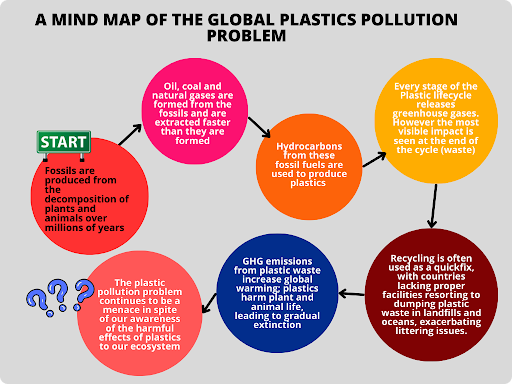
Pollution, climate change, and loss of biodiversity are all major problems that we are currently grappling with because of our resistance to thinking in systems. This resistance, whether borne out of nonchalance, ignorance, or a lack of understanding of how nature works, has brought severe consequences upon us in the last few years. The United Nations has revealed that the global average temperature for the most recent 10-year period (2014–2023) is now about 1.2°C warmer than it was in the pre-industrial era (1850–1900). The year 2023 was also announced as the warmest year on record, and 2011–2020 was the warmest decade on record for both land and ocean. Our oceans are also teeming with about 200 million metric tons of plastic waste, 99% of which is produced from nature’s limited fossil fuels.
What is a system, and what does it mean to think in terms of systems?
A system is an interconnected set of elements that is coherently organized in a way that achieves something…a system must consist of three kinds of things: elements, interconnections, and a function or purpose (Meadows, 2008, p. 11). According to this definition, a system is a network comprising different parts that work together as a whole to achieve a common purpose or goal crucial for the benefit of each part. For example, The harmonious functioning of all bodily organs is essential for human survival. In the event of cardiac failure, blood circulation to vital body parts is compromised, impeding our normal physiological process.
We can compare the human system to the way nature functions. All living organisms are reliant on one another for growth, survival, and sustenance. No living organism can thrive alone. A thriving ecosystem comprises decomposers, producers, and consumers. Decomposers such as fungi and bacteria rely on other deceased organisms for sustenance. Producers such as plants create their own sustenance but still rely on elements like sunlight, water, and carbon dioxide. Humans and other animals consume various organisms, including plants and other animals, for sustenance. For an ecosystem to thrive, it is essential to maintain a balance, ensuring decomposers do not overtake consumers or producers, and vice versa.
Embracing systems thinking means grasping the interconnectedness of a system to effectively preserve nature's resources for both present and future generations. In his book "Systems Thinking for Social Change," David P. Stroh defines it as understanding this interconnectedness to achieve a specific purpose, which in this case is fostering positive human interaction with nature and the planet, thus ensuring the sustainability of all living organisms and their future, including humans. We commonly tend to perceive ourselves as disconnected from nature, overlooking the profound interconnection between our existence and the natural world. This interconnectedness manifests in various ways, influencing our physical health, reproductive outcomes, and overall state of well-being. The intricate web of interactions between humans and the environment calls for a deeper understanding of the far-reaching implications of our relationship with nature.
THE CIRCULAR ECONOMY AS A SYSTEMS THINKING APPROACH FOR POSITIVE INTERACTION WITH NATURE
In light of our interconnectedness with nature, human beings rely on natural resources for raw materials used in production and consumption, which drives the global economy. During the production of goods and services, resources are extracted, processed, and consumed, with the remaining waste being discarded. This process is known as a linear economic model. The linear economic model is inherently extractive and has led to the depletion and destruction of nature, contributing to current climate change and environmental pollution problems. A linear economy fails to account for the balance required for an ecosystem to flourish, as it exemplifies consumers overpowering producers.
A circular economy is different from a linear process of production. It involves extending the life cycle of products, regenerating nature, and eliminating waste. In this economic model, resources never become waste because they are reintroduced into the production system, preserving resources that would have otherwise been extracted to produce new goods. This model employs the principles of systems thinking, which involve considering the interconnected nature of various elements within a system and aiming to achieve a state of equilibrium that benefits all components.
In his book "Systems Thinking for Social Change," David Stroh delves into the concept that while quick fixes may yield short-term success, they can lead to unintended consequences that become increasingly problematic over time. By extension, the linear economy, often seen as a quick fix for generating profits and sustaining the global economic system, has resulted in compounding issues that may become irreversible for current and future generations if our relationship with nature is not reevaluated and improved.
THE THREE-PILLAR MODEL FOR POSITIVE INTERACTION WITH NATURE
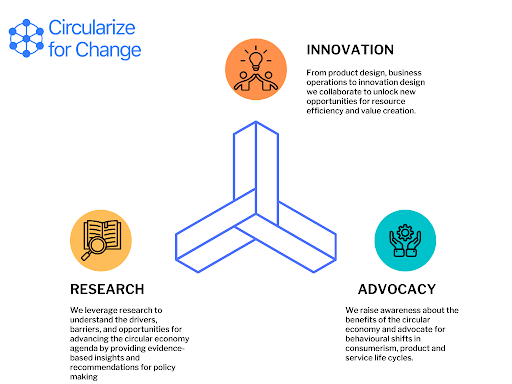
At Circularize for Change, we take cognizance of the barriers to adopting a circular economy and embrace the reality that long-lasting change takes time. Through advocacy, we aim to shift mental models to understand our interdependency with nature. By building a strong foundation through advocacy and awareness creation, we strive to phase out the linear economic model. The progression of knowledge is dynamic, and the transition from a linear economy needs a comprehensive investigation into the underlying causes of existing environmental challenges. Our research endeavors are dedicated to comprehending the catalysts, obstructions, and possibilities associated with advancing the circular economy agenda. We are committed to providing evidence-based insights and recommendations to facilitate policy formulation. Lastly, we collaborate with businesses, research institutions, and innovators to develop and scale technologies, business models, and practices that promote circularity and sustainability.
CONCLUSION
The Circular Economy Principle, underpinned by a systems thinking approach, provides a regenerative model for the preservation of nature. By fostering synergies among stakeholders and improving relationships within our economy and with nature, we can achieve a balanced state for the benefit of present and future generations.
REFERENCES
Interdependent Relationships in Ecosystems. (n.d.). Forest Founders. Retrieved June 20, 2024,
https://www.forestfounders.org/learning-center/interdependent-relationships-in-ecosystems
Kollmuss, A., & Agyeman, J. (2010, July 01). Why do people act environmentally, and what are the barriers to pro-environmental behavior? Environmental Education Research, 8(3), 239–260.
Meadows, D. H. (2008). Thinking in Systems: A Primer. Chelsea Green Publishing Co.
Stroh, D. P. (2019). Systems Thinking for Social Change. Chelsea Green Publishing.
Van Putten, I., Boschetti, F., Fulton, E. A., Smith, A. D., & Thebaud, O. (2014). Individual transferable quota contribution to environmental stewardship: a theory in need of validation. Ecology and Society, 19(2). https://www.jstor.org/stable/26269588

LICENSE No:
NPOS/GR01/LN01430/24
Mailing Address:
P. O. Box CT 6052, Cantonments,
Accra-Ghana
Contact Us
 info@circularizeforchange.org


