INC 5.2 Debrief: Implications for Advancing a Plastics Circular Economy in Africa
Taking Stock: Ghana's Performance Across the 17 SDGs in 2026
Introduction
The 17 United Nations Sustainable Development Goals (SDGs) were adopted by the UN in 2015. They act as a universal call to action to end poverty, protect the planet, and ensure that by 2030 all people can live in peace and prosperity (Sustainable Development Goals). Ghana is committed to achieving these goals that address the country’s major development challenges. At the core of this engagement lies the United Nations Development Cooperation Framework (2023-2025), which the Government of Ghana has extended for an extra year. This framework remains the most important instrument for planning and implementing UN development activities across Ghana (The United Nations, 2026).
Ghana’s Overall Performance
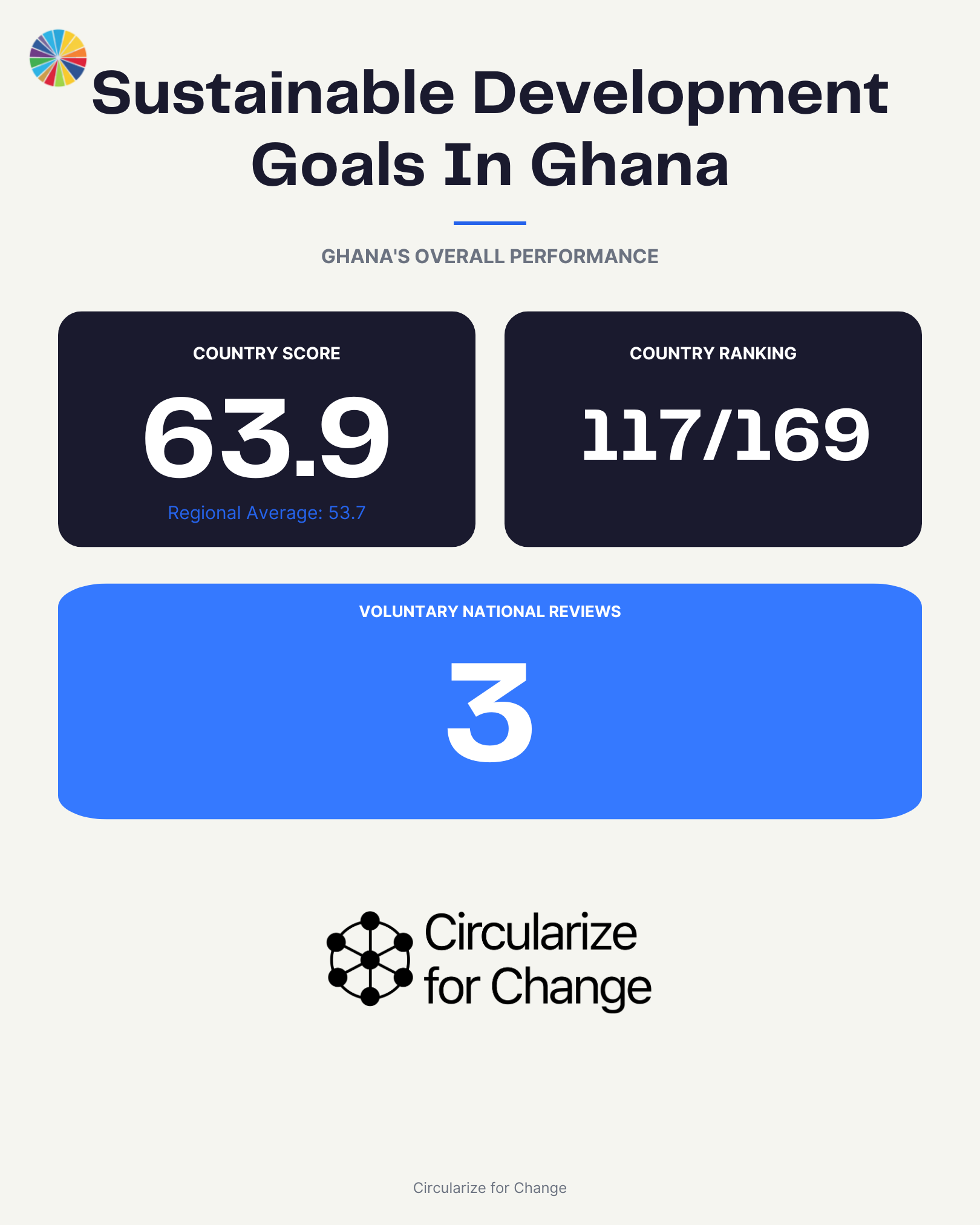
Ghana's developmental trajectory presents a nuanced picture, characterised by a combination of moderate advancements in certain areas while exhibiting stagnation in others. While initiatives are underway to address each goal, the intensity and effectiveness of these efforts vary significantly. Regionally, Ghana performs above average, achieving an overall score of 63.9, in contrast to a regional mean of 53.7 (Sustainable Development Report, 2026). Additionally, Ghana's spillover score stands at an impressive 93.6 out of 100, indicating that the positive outcomes stemming from its efforts outweigh any negative repercussions (Sustainable Development Report, 2026).
Areas of moderate progress
SDG 2: No Hunger
For Ghana, achieving Sustainable Development Goal 2 (SDG 2) continues to present considerable challenges; however, recent interventions have yielded moderate progress (Sustainable Development Report, 2026). The country’s strategic priorities encompass enhancing agricultural productivity through the adoption of climate-resilient practices, minimizing post-harvest losses, addressing micronutrient deficiencies, and effectively combating child stunting and wasting (President’s SDG Advisory Unit Ghana, 2026). These initiatives are primarily steered by grassroots agricultural organizations and women’s cooperatives, reinforcing community-based approaches (President’s SDGs Advisory Unit Ghana, 2026b).
A significant aspect of Ghana's food security advancements is its impressive capability to produce 95% of its staple foods domestically, thereby reducing dependence on imports (President’s SDGs Advisory Unit Ghana, 2026b). Undernourishment rates reached a historic low of 5.6% in 2021, and the exportation of hazardous pesticides has significantly declined (Sustainable Development Report, 2026). Moreover, high cereal yields and elevated human trophic levels indicate improvements in nutritional access across the population (Sustainable Development Report, 2026). Nonetheless, challenges persist, particularly with the unacceptably high rates of child malnutrition and the ongoing difficulties in establishing sustainable agricultural practices (Sustainable Development Report, 2026).
SDG 3: Good Health and Well-being
Good health and well-being in Ghana is still a major challenge the country faces, however, it is moderately improving (Sustainable Development Report, 2026). Ghana is working towards improving healthcare access, quality, and affordability while addressing persistent challenges like maternal and child mortality, infectious diseases (malaria, HIV/TB), and the growing burden of non-communicable diseases (e.g., hypertension, diabetes) (President’s SDGs Advisory Unit Ghana, 2026c). The country is prioritising strengthening primary healthcare, achieving universal health coverage through the National Health Insurance Scheme (NHIS), and enhancing health emergency preparedness (President’s SDGs Advisory Unit Ghana, 2026c). This is best practised through the Community-Based Health Planning and Services (CHPS), where local nurses and volunteers deliver healthcare and education to remote villages, drastically improving accessibility (President’s SDGs Advisory Unit Ghana, 2026c). One of Ghana’s most recent achievements in this area is its role out of vaccines with 98% of children ages 12-13 months receiving the BCG vaccine and 95% having their first dose of the measles vaccine (President’s SDGs Advisory Unit Ghana, 2026c) Mortality rates are children under 5 are also down to a score of 35.88 as well as the rate of new HIV infections and the number of health care professional attending births is also up (Sustainable Development Report, 2026). These are crucial steps towards reducing child mortality and fighting infectious diseases. Incidents of TB have become stagnant in recent years, and challenges persist in establishing universal healthcare and adolescence pregnancies (Sustainable Development Report, 2026).
SDG 4: Quality Education
The challenge of providing high-quality education within a safe and inclusive environment persists in Ghana, although recent initiatives indicate progress towards this objective (Sustainable Development Report, 2026; President’s SDGs Advisory Unit Ghana, 2026d). Key strategic priorities include enhancing foundational literacy and numeracy, broadening access to secondary and vocational education, and addressing the pronounced gender and regional disparities in educational resources and outcomes (President’s SDGs Advisory Unit Ghana, 2026d). Community-driven initiatives, such as Schools for Life, aim to deliver basic education to out-of-school children, ensuring equitable learning opportunities across communities (President’s SDGs Advisory Unit Ghana, 2026d). Notably, Ghana has recently achieved gender parity in primary school enrollment, with net enrollment rates recorded at 85% for boys and 86% for girls (President’s SDGs Advisory Unit Ghana, 2026d). While literacy rates and secondary school completion have shown improvement, schools continue to grapple with significant infrastructure deficits, and there remains a concerning lack of enrollment in organized pre-primary education (Sustainable Development Report, 2026; President’s SDGs Advisory Unit Ghana, 2026d).
SDG 6: Clean Water and Sanitation
Clean water and sanitation remain a major challenge for Ghana, but there have been improvements made to expand infrastructure, provide safe drinking water, and address the gap in sanitation and hygiene services (President’s SDGs Advisory Unit Ghana, 2026f; Sustainable Development Report, 2026). Key priorities include eliminating open defecation, improving wastewater treatment, protecting water resources from pollution, and enhancing resilience to water-related climate shocks (President’s SDGs Advisory Unit Ghana, 2026f). Grassroots initiatives are at the heart of achieving these goals by empowering and equipping them to manage their own water systems, maintain hygiene standards, and collectively end open defecation (President’s SDGs Advisory Unit Ghana, 2026f). Accessible drinking water has increased to 88% of the population (2022), which shows significant progress in expanding the foundational infrastructure for safe water access and is a crucial first step to reducing waterborne diseases and improving overall health and productivity (President’s SDGs Advisory Unit Ghana, 2026f). Freshwater withdrawal from all major sectors and water scarcity have decreased (Sustainable Development Report, 2026). Major challenges still persist in sanitation with 34% of people having basic access, and hygiene, with 42% having access to handwashing facilities as well as a lack of treatment of water waste (President’s SDGs Advisory Unit Ghana, 2026f)
SDG 7: Affordable and Clean Energy
Closing the electricity gap, especially in rural and underserved communities, while shifting towards more renewable sources, is a significant challenge for Ghana (President’s SDG Advisory Unit Ghana, 2026; Sustainable Development Report, 2026d). The country is prioritising i the improvement of grid reliability, promoting clean cooking solutions to replace wood and charcoal, and encouraging energy efficiency (President’s SDG Advisory Unit Ghana, 2026d). Local entrepreneurs and cooperatives are leading the expansion of decentralized solar mini-grids and home systems to provide affordable, renewable energy to off-grid communities (President’s SDG Advisory Unit Ghana, 2026d). Ghana has one of the highest national electricity rates in Sub-Saharan Africa due to its highly successful expansion of national grid access, and CO2 emissions from combustion are decreasing (President’s SDG Advisory Unit Ghana, 2026d; Sustainable Development Report, 2026). In sum, Ghana is still facing the main challenges of eliminating the urban-rural access gap, addressing the reliance on unclean cooking methods, and diversifying its energy mix.
SDG 8: Decent Work and Economic Growth
Creating quality jobs, especially for the youth population with 1/5 currently in employment or education, whilst transitioning existing workers to the formal, protected sector remains a significant challenge for Ghana (President’s SDG Advisory Unit Ghana, 2026e; Sustainable Development Report, 2026). Key priorities include fostering entrepreneurship, supporting resilient sectors like technology and agriculture, ensuring fair wages and safe working conditions, and achieving economic growth that actively reduces poverty (President’s SDG Advisory Unit Ghana, 2026e). Community-based initiatives are providing training, access to capital and market linkages, empowering young people and small farmers to create sustainable businesses and generate livelihoods in their communities (President’s SDG Advisory Unit Ghana, 2026e). ICT and FinTech have shown significant growth, with mobile money transactions reaching GH¢1.4 trillion (~$118 billion) in 2023, opening up new digital economic opportunities (President’s SDG Advisory Unit Ghana, 2026e).
SDG 13: Climate Action
Ghana is making progress towards building up climate resilience to protect agriculture and livelihoods while also contributing to global mitigation efforts (President’s SDG Advisory Unit Ghana, 2026f; Sustainable Development Report, 2026). Ghana is prioritising implementing the National Climate Change Policy, strengthening early warning systems, promoting climate-smart agriculture, and accessing international finance for adaptation projects (President’s SDG Advisory Unit Ghana, 2026f). Community efforts are at the front lines of implementing these changes, with local farmers adopting climate-smart techniques and coastal communities restoring mangroves (President’s SDG Advisory Unit Ghana, 2026f). Ghana has a long-term commitment to climate action laid out in its long-term low-carbon development strategy where they aim to be net-zero by 2070 (President’s SDG Advisory Unit Ghana, 2026f). Green House Gas (GHG) emissions are also low in imports however, exports remain high, and emissions from fossil fuel combustion and cement are rising (Sustainable Development Report, 2026). Despite Ghana’s strong frameworks and commitments to climate action, mobilizing sufficient funds to implement these plans remains a challenge (President’s SDG Advisory Unit Ghana, 2026f).
Areas of Stagnant Progress
SDG 1: No poverty
Eradicating poverty is a major issue for Ghana (Sustainable Development Report, 2026). The country is prioritising expanding social protection programs, promoting inclusive economic opportunities, and targeting support to the most vulnerable groups in the hope of eradicating extreme poverty, reducing multi-dimensional poverty and strengthening resilience to economic, social, and environmental shocks (President’s SDGs Advisory Unit Ghana, 2026a). These efforts are led by local savings and loan associations, farmer cooperatives, and community-led social initiatives, which are providing financial inclusion, livelihood support, and safety nets that are empowering households to build sustainable incomes (President’s SDGs Advisory Unit Ghana, 2026a). Ghana has significantly reduced its extreme poverty rates from 52% in 1992 to 10% in 2023; however, multi-dimensional poverty remains high and progress is uneven, with rural areas suffering the most (President’s SDGs Advisory Unit Ghana, 2026a)
SDG 5: Gender Equality
Confronting deep-seated cultural and social norms to eliminate discrimination and violence against women and girls remains a major challenge for Ghana (President’s SDGs Advisory Unit Ghana, 2026e; Sustainable Development Report, 2026). Initiatives are driven by local women’s rights groups who are at the forefront of protecting girls from early marriage, promoting girls' education, supporting female entrepreneurs with financial literacy, and providing safe spaces and legal aid for survivors of gender based violence (President’s SDGs Advisory Unit Ghana, 2026e). Whilst Ghana has made strides towards gender equality in education, reduced harmful practices such as FGM, and increased the male: female ratio in the workforce (President’s SDGs Advisory Unit Ghana, 2026e; Sustainable Development Report, 2026). Major gaps persist in economic empowerment, political power and representation, and safety of women and girls (President’s SDGs Advisory Unit Ghana, 2026e).
SDG 9: Industry, Innovation and Infrastructure
Ghana is aiming to address gaps in transportation and digital networks, boost domestic and manufacturing value, and create an enabling environment for technological innovation and entrepreneurship (President’s SDGs Advisory Unit Ghana, 2026i). Key priorities include bridging the rural-urban infrastructure divide, supporting small and medium-sized businesses to industrialize, and leveraging innovation for sustainable development (President’s SDGs Advisory Unit Ghana, 2026i). Local tech hubs and innovation centres across regions provide budding entrepreneurs with training, mentorship and resources to develop solution-based businesses (President’s SDGs Advisory Unit Ghana, 2026i). There is also a consistently high amount of the population who are using the internet (Sustainable Development Report, 2026). Ghana has built a strong digital infrastructure backbone; however, it is still facing significant challenges in traditional physical infrastructure, with stagnant industrialisation and low investment in research and development (President’s SDGs Advisory Unit Ghana, 2026i).
SDG 11: Sustainable Cities and Communities
Managing rapid urbanization by ensuring access to adequate housing, affordable basic services, and green public spaces remains a major challenge for Ghana to overcome (President’s SDGs Advisory Unit Ghana, 2026j; Sustainable Development Report, 2026). The country is prioritising upgrading informal settlements (slums), improving waste management and air quality, strengthening public transport, and making cities resilient to climate change and disasters (President’s SDGs Advisory Unit Ghana, 2026j). Grassroots groups in partnership with local authorities are leading the implementation of these initiatives by working to improve sanitation, secure land tenure, create green spaces, and advocate for better infrastructure (President’s SDGs Advisory Unit Ghana, 2026j). Access to basic services has improved as electricity has reached over 90% of urban areas and access to water sources is nearly universal, with 96% of people having access (President’s SDGs Advisory Unit Ghana, 2026j). However, challenges, such as inadequate waste management, deficient green spaces, a lack of public transport and the spread of slums, persist because of the rapid, unplanned growth (President’s SDGs Advisory Unit Ghana, 2026e; Sustainable Development Report, 2026).
SDG 12: Responsible Consumption and Production
Ghana has successfully achieved Sustainable Development Goal (SDG) 12, demonstrating a marked decoupling of economic growth from environmental degradation through enhanced resource efficiency, waste reduction across value chains, and the facilitation of sustainable choices for both businesses and consumers (President’s SDGs Advisory Unit Ghana, 2026k; Sustainable Development Report, 2026). The country has made significant strides in policy development, notably through its National Plastic Management Policy and participation in the UN-led One Planet Network Sustainable Consumption and Production initiative (President’s SDGs Advisory Unit Ghana, 2026k). However, Ghana is still in the nascent stages of establishing a circular economy. Current economic activities remain predominantly linear, characterized by inefficient consumption and production patterns. This includes considerable post-harvest losses, an escalating e-waste dilemma, and a critical plastic pollution challenge (President’s SDGs Advisory Unit Ghana, 2026k). The lack of progress in addressing these issues, particularly concerning plastic waste exports and emissions production, poses a risk of regression on SDG 12 in the forthcoming years (Sustainable Development Report, 2026).
SDG 14: Life Below Water
Ghana is currently tackling severe threats to life underwater like overfishing, illegal fishing, and plastic pollution, which remain major challenges in the country (President’s SDGs Advisory Unit Ghana, 2026m; Sustainable Development Report, 2026). Key priorities include restoring fish stocks, protecting marine habitats, reducing ocean pollution, and supporting sustainable small-scale fisheries that millions depend on for food and income (President’s SDGs Advisory Unit Ghana, 2026m). These changes are being driven by local fishing communities who are adopting government-enforced closed seasons since 2019 and forming marine surveillance committees; these efforts ensure that fish stocks recover for future generations (President’s SDGs Advisory Unit Ghana, 2026m). Despite these positive policy actions, the overwhelming trends of stock depletion, plastic pollution and habitat loss threaten food security and livelihoods and indicate a need for stronger enforcement and community-led conservation (President’s SDGs Advisory Unit Ghana, 2026m).
SDG 15: Life on Land
Ghana is focusing its efforts on restoring forest cover, promoting sustainable agriculture, strengthening protected areas to help protect its unique wildlife, and supporting communities to manage land resources sustainably (President’s SDG Advisory Unit Ghana, 2026g). These efforts are led by community resource management areas (President’s SDG Advisory Unit Ghana, 2026g). There is a strong political will for reforestation in Ghana, exemplified in the Ghana Forest Plantation Strategy, which aims to restore 2 million hectares of degraded landscape by 2030 and initiatives like Green Ghana Day, which plants millions of trees annually (President’s SDG Advisory Unit Ghana, 2026g). Ghana also has large areas of protected terrestrial and freshwater areas that are important to biodiversity (Sustainable Development Report, 2026). Whilst Ghana does have ambitious government-led restoration programs, their success relies on addressing its high deforestation rates, caused by agriculture and mining, and empowering local communities to be the stewards of conservation (President’s SDG Advisory Unit Ghana, 2026g)
SDG 16: Peace, Justice and Strong Institutions
Ghana is currently aiming to strengthen governance, reduce corruption, ensure equal access to justice for all and maintain peace amidst regional instability (President’s SDGs Advisory Unit Ghana, 2026o). They are prioritising enhancing judicial efficiency, promoting transparency and accountability in public institutions, and protecting fundamental freedoms for all citizens (President’s SDGs Advisory Unit Ghana, 2026o). Grassroots initiatives often led by civil society and traditional leaders are working to provide accessible justice and hold those in government accountable (President’s SDGs Advisory Unit Ghana, 2026p; Sustainable Development Report, 2026). Ghana maintains relative peace and a functioning democracy with a relatively free and vibrant media landscape that is key to holding the government accountable (President’s SDGs Advisory Unit Ghana, 2026o). However, the government's management of crime, access to justice and birth registration all still remain challenges for Ghana (Sustainable Development Report, 2026).
SDG 17: Partnership for the Goals
Mobilizing financial resources, enhancing technology, and building capacity to achieve all other SDGs is a major challenge for Ghana. Local public partnerships demonstrate that the key priorities include increasing domestic revenue mobilization, attracting responsible foreign investment, leveraging digital technology, and fostering multi-stakeholder collaborations between government, private sector, and civil society (President’s SDGs Advisory Unit Ghana, 2026p). Collaborative community efforts are proving effective in delivering sustainable solutions, sharing resources and building local capacity to drive development (President’s SDGs Advisory Unit Ghana, 2026p). For Ghana to achieve all of the goals they will require stronger, more aligned partnerships and increased investment in critical sectors such as renewable energy, education and sustainable agriculture (President’s SDGs Advisory Unit Ghana, 2026p)
Conclusion
Ghana’s Government has made notable policy efforts and endorsements towards the implementation of SDGs. Ghana’s president has shown outward support of the implementation of SDGs with the establishment of a dedicated advisory unit, incorporation of SDGs in the 2030 agenda, and considering them in the country's budget (Sustainable Development Report, 2026). Progress is also being monitored by set national indicators and a national-level audit (Sustainable Development Report, 2026).
This report indicates that one of the most significant impediments to Ghana's progress toward achieving its Sustainable Development Goals (SDGs) is inadequate financial resources. Despite the presence of robust policies and initiatives, the realization of transformative changes, particularly in terms of infrastructure development and technological innovation, requires substantial funding that is currently lacking.
Additionally, community engagement presents another challenge, as sustained progress in certain regions may hinge on collaborative efforts. Although many communities are presently supportive of these initiatives, the potential for stagnation exists if cooperative momentum wanes.
Critical sectors that may be impacted include clean water (SDG 6), clean energy (SDG 7), climate action (SDG 13), and life on land (SDG 15). Overall, while Ghana demonstrates variable progress across different sectors, there is a coherent strategy in place aimed at achieving all of the goals.
Bibliography
President’s SDGs Advisory Unit Ghana (2026a) Goal 1 – President’s SDGs Advisory Unit Ghana.
President’s SDGs Advisory Unit Ghana (2026b) Goal 2 – President’s SDGs Advisory Unit Ghana Available from https://sdgsghana.gov.gh/index.php/goal-2/ [accessed 14 July 2026].
President’s SDGs Advisory Unit Ghana (2026c) Goal 3 – President’s SDGs Advisory Unit Ghana. Available from https://sdgsghana.gov.gh/index.php/goal-3/ [accessed 14 July 2026].
President’s SDGs Advisory Unit Ghana (2026d) Goal 4 – President’s SDGs Advisory Unit Ghana. Available from https://sdgsghana.gov.gh/index.php/goal-4/ [accessed 14 July 2026].
President’s SDGs Advisory Unit Ghana (2026e) Goal 5 – President’s SDGs Advisory Unit Ghana.
President’s SDGs Advisory Unit Ghana (2026f) Goal 6 – President’s SDGs Advisory Unit Ghana. Available from https://sdgsghana.gov.gh/index.php/goal-6/ [accessed 14 July 2026].
President’s SDGs Advisory Unit Ghana (2026g) Goal 7 – President’s SDGs Advisory Unit Ghana. Available from https://sdgsghana.gov.gh/index.php/goal-7/ [accessed 14 July 2026].
President’s SDGs Advisory Unit Ghana (2026h) Goal 8 – President’s SDGs Advisory Unit Ghana. Available from https://sdgsghana.gov.gh/index.php/goal-8/ [accessed 14 July 2026].
President’s SDGs Advisory Unit Ghana (2026i) Goal 9 – President’s SDGs Advisory Unit Ghana. Available from https://sdgsghana.gov.gh/index.php/goal-9/ [accessed 15 July 2026].
President’s SDGs Advisory Unit Ghana (2026j) Goal 11 – President’s SDGs Advisory Unit Ghana. Available from https://sdgsghana.gov.gh/index.php/goal-11/ [accessed 16 July 2026].
President’s SDGs Advisory Unit Ghana (2026k) Goal 12 – President’s SDGs Advisory Unit Ghana. Available from https://sdgsghana.gov.gh/index.php/goal-12/ [accessed 16 July 2026].
President’s SDGs Advisory Unit Ghana (2026l) Goal 13 – President’s SDGs Advisory Unit Ghana. Available from https://sdgsghana.gov.gh/index.php/goal-13/ [accessed 15 July 2026].
President’s SDGs Advisory Unit Ghana (2026m) Goal 14 – President’s SDGs Advisory Unit Ghana. Available from https://sdgsghana.gov.gh/index.php/goal-14/ [accessed 16 July 2026].
President’s SDGs Advisory Unit Ghana (2026n) Goal 15 – President’s SDGs Advisory Unit Ghana. Available from https://sdgsghana.gov.gh/index.php/goal-15/ [accessed 15 July 2026].
President’s SDGs Advisory Unit Ghana (2026o) Goal 16 – President’s SDGs Advisory Unit Ghana. Available from https://sdgsghana.gov.gh/index.php/goal-16/ [accessed 16 July 2026].
President’s SDGs Advisory Unit Ghana (2026p) Goal 17 – President’s SDGs Advisory Unit Ghana. Available from https://sdgsghana.gov.gh/index.php/goal-17/ [accessed 16 July 2026].
Sustainable Development Goals (n.d.) Available from https://www.undp.org/sustainable-development-goals [accessed 14 July 2026].
Sustainable Development Report (2026) Ghana’s Sustainable Development Report 2026.
The United Nations (2026) Sustainable Development Goals | United Nations in Ghana. Available from https://ghana.un.org/en/sdgs [accessed 14 July 2026].
Author: Katie Burn
As a Research and Partnerships Intern at Circularize for Change (C4C), Katie supports research, stakeholder engagement, and partnership development to advance environmental and social impact initiatives. Over the past year, she has contributed to several projects, most notably with Lincolnshire County Council, where she coordinated a student-led initiative to develop and enhance its work experience programme for young people aged 14–18 within the local community.

LICENSE No:
NPOS/GR01/LN01430/24
Mailing Address:
P. O. Box CT 6052, Cantonments,
Accra-Ghana
Contact Us
 info@circularizeforchange.org


